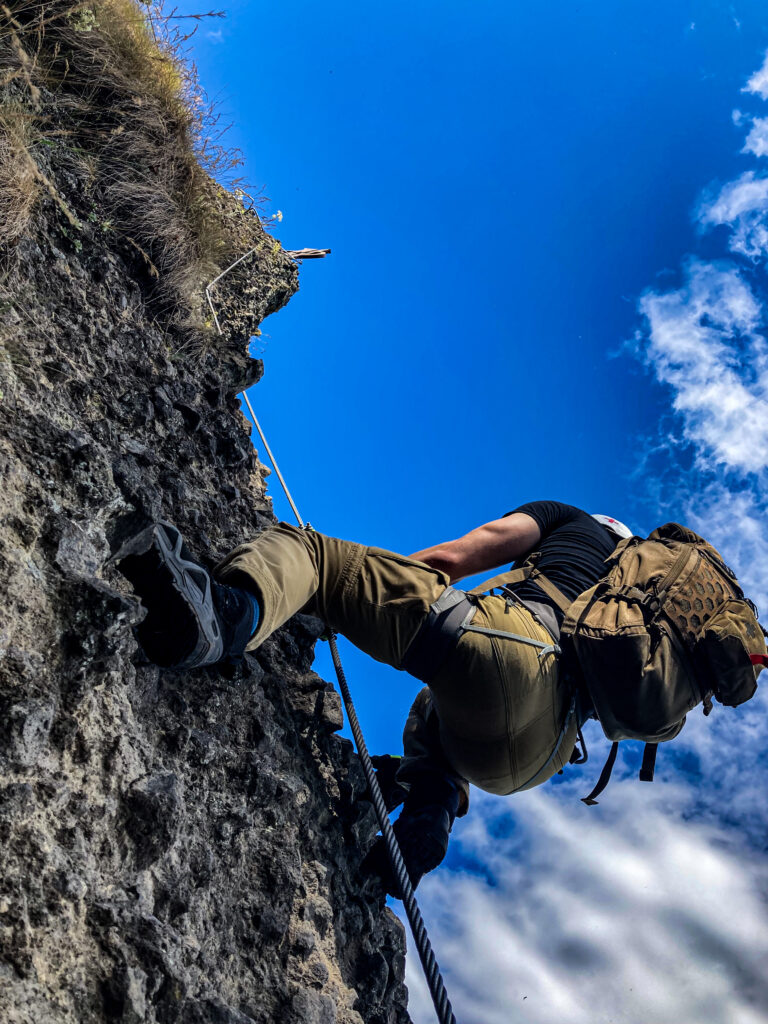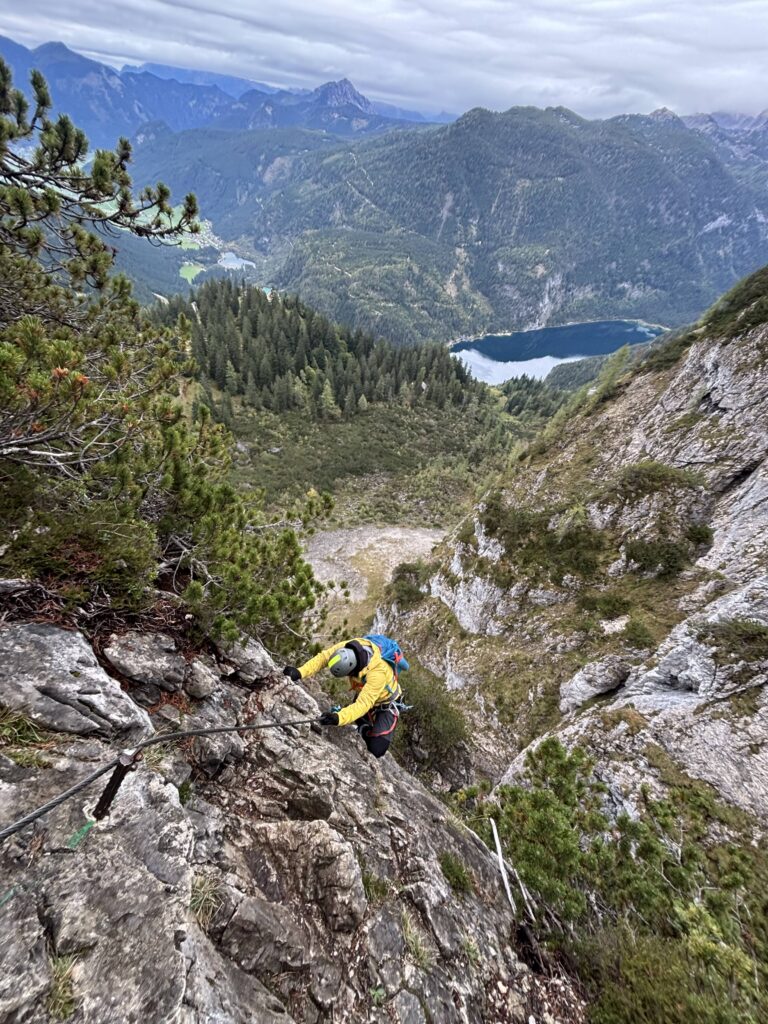
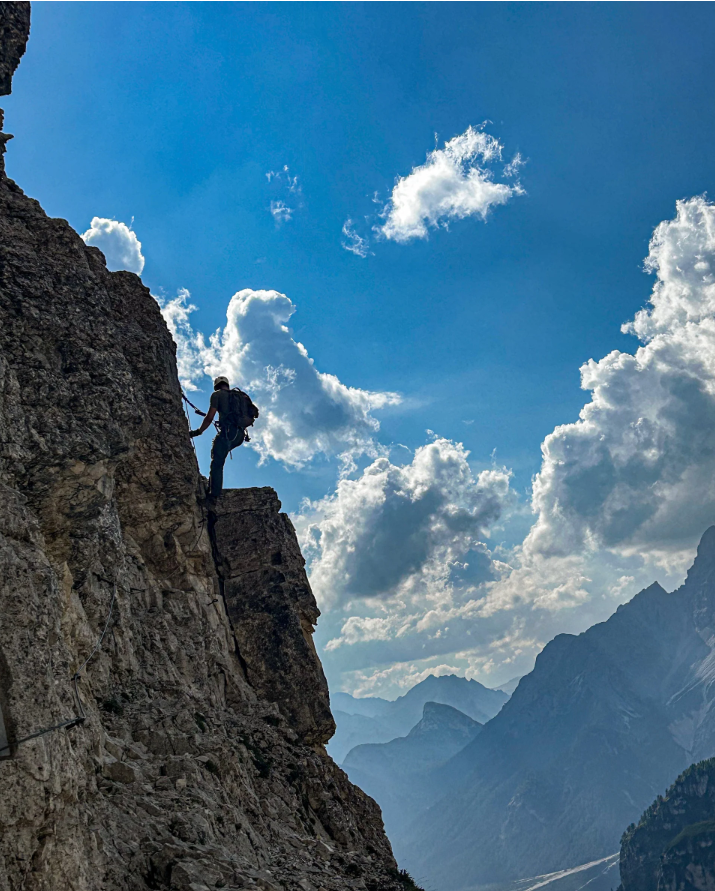
Some Austrian via ferratas put you above a turquoise lake. Others lead beside a waterfall or onto a mountain ridge with the valley a long way below. Choosing between them is exciting—but the best route is the one that matches your experience, your head for heights and the kind of day you want.
This is a practical shortlist of four of the best via ferratas in Austria for different experiences, from a short practice route to the famous Donnerkogel Sky Ladder. You will learn how to compare them, what the difficulty letters actually tell you, and what to check before making plans.
IN THIS GUIDE
Which Austrian via ferrata should you choose?
Use this table as a shortlist, then read the current route description and topo. A grade describes technical difficulty; it does not tell you whether the approach is snowy, how you will feel above a drop, or whether the descent is within your ability.
| Route / area | Grade | What makes it worth considering | Who should consider it |
|---|---|---|---|
| Piburg Oetz, Ötztal | Mostly A/B; short B/C | A compact practice outing | Newcomers with instruction; a low-commitment place to learn |
| Laserer Alpin Gosausee | C | Lake views, traverses and exposure | People comfortable with heights and steeper cable sections |
| Stuibenfall Umhausen, Ötztal | C | Waterfall scenery and a cable bridge | Fit climbers with prior via ferrata or climbing experience |
| Donnerkogel Gosau / Zwieselalm | C/D | The Sky Ladder within a demanding mountain route | Experienced ferrata climbers; suitability needs careful assessment |
Grades checked against Ötztal’s Piburg route page, the Salzkammergut via ferrata guide and Climbers Paradise’s Stuibenfall description. These are route descriptions, not live opening reports.
What do A, B, C and D mean?
In Austria you will often see the word Klettersteig: it means via ferrata. Routes commonly use letter grades running from A for easier sections through progressively more difficult terrain. A mixed grade such as C/D describes a section between those levels. Always look at the hardest section, not just the average.
Think of the grade and the length as two separate questions. Can you manage the hardest moves? And can you still do them after a long approach, a queue and an hour or two on the cable? Exposure adds another layer: a move that feels simple close to the ground can feel very different above a deep drop. Ötztal’s via ferrata planning overview also highlights route length, access, descent and exit options.
For your first day: aim to finish wanting more. A short route with instruction gives you space to become familiar with the equipment and discover how you react to height. A famous photograph is a reason to be curious, not a measure of readiness.
1. Piburg: start with a short learning session
Choose it for: an introduction near Oetz in the Ötztal, with a much smaller time commitment than a mountain summit route.
The Piburg practice ferrata is around 192 metres long with 28 metres of height gain. Ötztal lists mainly A/B climbing with a short B/C section, and roughly 20 minutes on the route itself. Allow extra time for getting there, equipment checks and learning. Short does not mean that the protection system or instruction is optional.
Its useful role in a trip is as a first session or a confidence check before committing to a bigger objective. The official description notes that this shaded location can remain wet after rain. It also restricts use to April–November, between 08:00 and 20:00; check the current conditions and access rules before you go. Read the official Piburg route details →
2. Laserer Alpin: dramatic views above Gosausee
Choose it for: a compact outing with the visual drama of the Dachstein landscape and climbing just above the lake.
Laserer Alpin follows rock beside Gosausee, with traverses, a ladder and a cable bridge forming a circuit. The regional guide gives it grade C. The tourism route page describes an approach of about 15 minutes along the lakeside path; its proximity to the path does not remove the exposure or the physical demands of the climbing.
For someone who has already learned the basics, the appeal is the combination of varied movement and scenery without making a summit the whole purpose of the day. If you are a complete newcomer, discuss suitability with an instructor before treating it as your first independent route. Read the official Laserer Alpin route description →
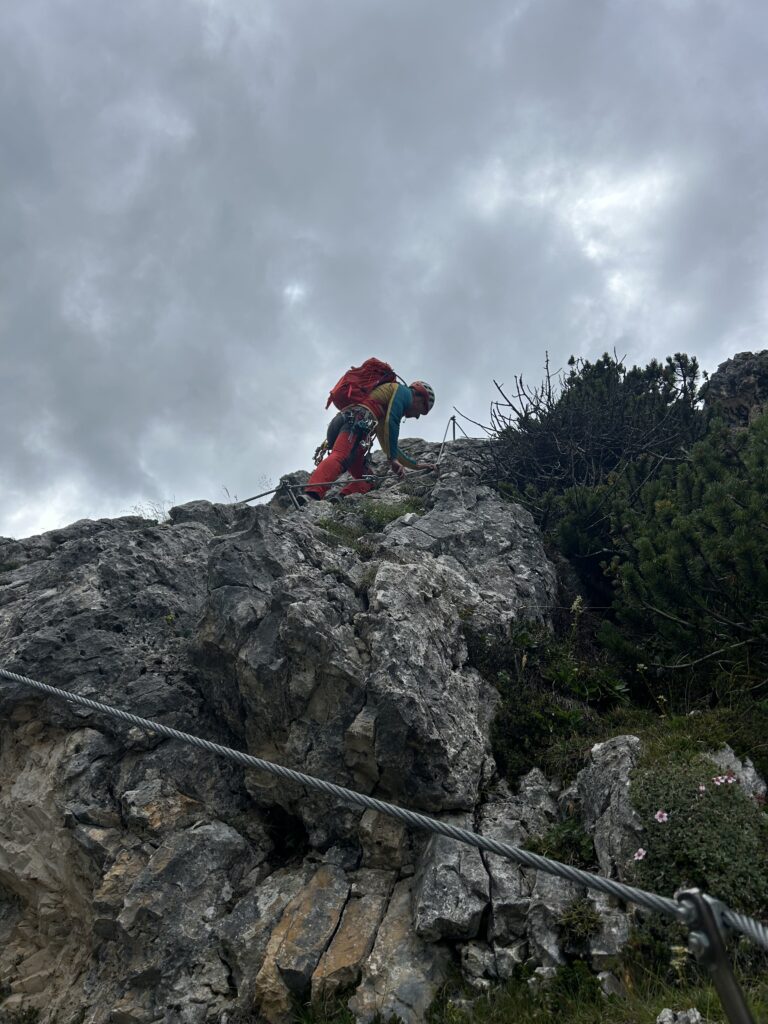
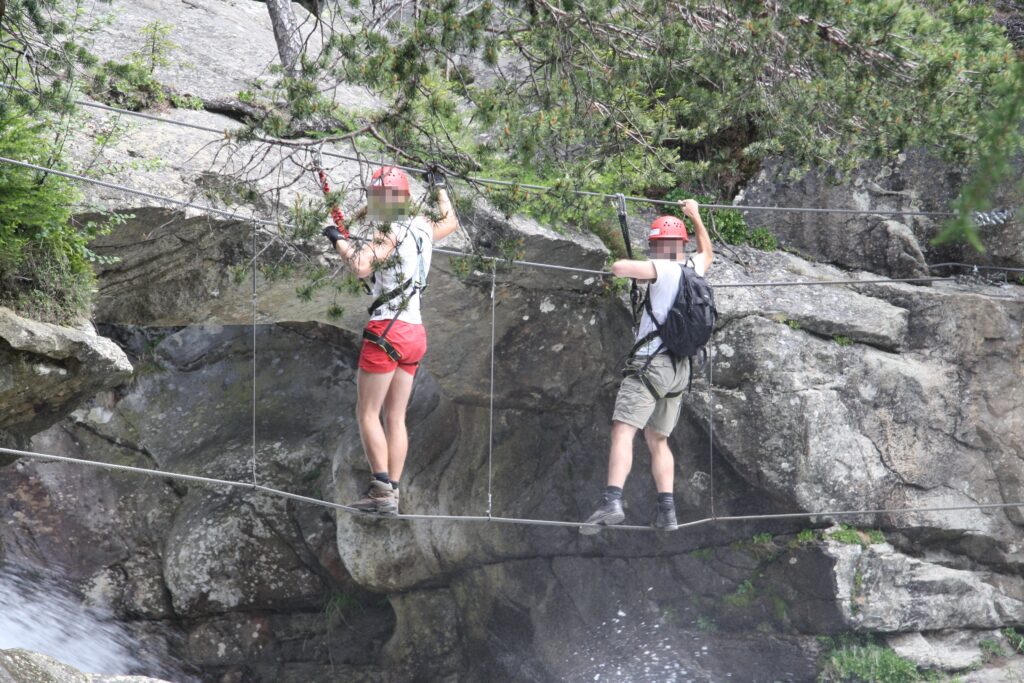
3. Stuibenfall: climb beside a waterfall
Choose it for: the atmosphere of moving beside rushing water, with a route that feels different from a dry limestone ridge.
Above Umhausen, the Stuibenfall ferrata is rated C and has around 400 metres of climbing with 210 metres of height gain. Climbers Paradise gives about 30 minutes for the approach, 1½ hours for the ferrata and 45 minutes for the descent. These are planning estimates, not a timetable for every group.
The route includes exposed traversing and steeper moves. Near the top, the bridge over the water has an alternative finish. The official description calls for prior via ferrata or climbing experience, fitness, surefootedness and a head for heights, with a minimum height of 1.4 metres. Take those requirements seriously rather than assuming a popular waterfall attraction is an introductory activity. Read the current Stuibenfall route information →
4. Donnerkogel: the Sky Ladder is only part of the day
Choose it for: a bigger mountain experience with the famous 40-metre Sky Ladder—once your experience matches the route.
Donnerkogel’s “Stairway to Heaven” sits within a C/D via ferrata above Gosau. The regional tourism description allows around three to four hours for the climbing and five to six hours including the descent when using the upper cable-car station as the approach base. Starting lower adds effort and time. The ladder is the photograph everyone recognises, but demanding climbing elsewhere on the route is part of the commitment.
This is not a sensible default first independent ferrata. Build experience on less committing routes and discuss your ability with a guide if you are unsure. The official page describes a typical mid-June to mid-October season; snow, weather and lift operation can narrow that window. Check the official Donnerkogel information →
Interested in this objective? Our Donnerkogel adventure page explains the planned trip, meeting point and inclusions. Ask about suitability and current conditions before making travel arrangements, especially for a late-season date.
Plan the whole mountain day
A good plan starts before you choose the most photogenic route. Decide where you will stay, how much time you have and how far you want to drive. Piburg and Stuibenfall sit in the Ötztal; Laserer Alpin and Donnerkogel belong to the Gosau area. Treat them as two possible bases rather than trying to squeeze all four into one busy weekend.
Leave a flexible day in the itinerary. It can become a learning session, a rest day or a weather buffer. Booking accommodation around a single must-do route makes it much harder to make a sensible decision when conditions change.
When is the best time?
There is no single Austrian via ferrata season that applies to every altitude and aspect. Check the route operator’s dates, recent conditions and the mountain forecast close to departure. A warm day in the valley does not establish that an upper approach or descent is snow-free. For lift-assisted routes, check the first and last service and plan a realistic return margin.
What should you bring?
The basic protection is a properly fitted climbing harness, climbing helmet and an appropriate energy-absorbing via ferrata set used according to its manufacturer’s instructions. Add footwear suited to the approach and descent, weather layers, water, food, navigation and emergency essentials. Gloves can improve comfort, but they do not replace good technique or correct equipment.
- Learn how to use the equipment with competent instruction and do a partner check before starting.
- Choose a route within everyone’s ability; include the approach and descent in the plan.
- Do not enter a ferrata with a thunderstorm threat or ignore a closure or damaged protection.
- Allow space between climbers, watch for rockfall and keep checking time, weather and energy.
These essentials follow the Austrian Alpine Club’s ten recommendations for via ferrata. An article is useful preparation; it cannot replace practical instruction or an up-to-date route topo.
Questions people ask before their first ferrata
Can beginners do via ferratas in Austria?
Yes, with an appropriate route and practical instruction. “Beginner” covers very different levels of fitness, climbing experience and confidence at height. Start by discussing those honestly. A short practice route is a useful starting point; a C/D mountain route should not be chosen simply because it is famous.
Do I need a guide?
If you do not yet know how to select and use the equipment or judge whether a route fits your ability, guided instruction is a valuable first step. Tell the organiser what you have actually done, how you feel about exposure and whether you have any concerns that affect participation. Being generally fit is useful, but it is not the same as ferrata experience.
Is the Donnerkogel ladder suitable as a first route?
Do not assess the outing from the ladder alone. Donnerkogel is a sustained mountain trip with C/D sections. Build up on easier objectives and ask for an individual suitability assessment before committing. A guided booking does not make the route’s demands disappear.
Can I rent the equipment?
Check rental availability, opening hours and sizing with your chosen provider before travelling. A rental set does not include instruction unless that is explicitly offered. Our event pages state what equipment is included for each departure, so you can see what you still need to bring.
Find your own way into the mountains
The most memorable first ferrata is not necessarily the hardest. It is the day when you understand the equipment, find a rhythm on the rock and realise that the view feels earned. Start with an honest picture of your experience and choose the next step from there.
Explore our via ferrata adventures and courses, browse the upcoming trips below, or ask about a private day. Tell us your dates, group size, experience and preferred region; we can talk through a suitable plan.
About this guide. Researched on 2 October 2026 using regional tourism, Climbers Paradise and Austrian Alpine Club sources linked throughout. Route access, cable condition, lift schedules and weather can change. Confirm current information locally before every outing. The A&S photographs illustrate mountain climbing; their exact routes are not identified.